Categoría: Text

  • I saw her again

    I saw her again.
    Just the same, only farther away.
    Her skin, morning mist.
    Her hair, water in a drought.
    And those little dimples on her back —
    like promises that were never meant for me.
    Why show her to me, God?
    Why, if she’s as distant as the sky?

    But before, God, before…
    before she wasn’t air, or smoke,
    or that high cloud I can’t reach.
    Before, she was my company at the table,
    her hand just this close to mine —
    close as the fire in December
    that you can feel if you stretch out your fingers.

    How could I forget that smell?
    It wasn’t fine perfume from a bottle, no sir.
    It was the smell of earth after a fresh rain,
    of chamomile boiled with cinnamon —
    that smell that clings to your jacket
    and that you look for on the pillow before sleeping.

    And that little inside sound, that quiet drum…
    It was a soft galloping in her chest.
    When I put my ear to her,
    I’d forget even my hunger.
    Now I’m lulled by the buzzing of a fly,
    and the distant barking of a dog lonelier than me.

    Why did you give me the memory
    of the warm weight of her braid against my face?
    Why did I ever know what it’s like to have honey right there, in my mouth,
    if now everything tastes like ash, like gall?

    I saw her again, yes.

    But dreamed, she’s like trying to stop the sun with your bare hands.
    And you know she’ll leave.
    You know the night is a black bitch that swallows everything.
    No matter how hard you cling to the mountain,
    the darkness comes on time, like death.
    The mountain swallows her, and you’re left trembling,
    with the afterglow still hanging from your eyelashes.

    Oh, woman of my dreams.
    How I wish I’d never wake up.
    How I wish the night didn’t exist,
    and that dawn would always come with your hair tangled in mine.
    But here I am,
    with the rooster crowing lies
    and the bed empty of you.

  • Case 38

    I make a living debunking supernatural claims.

    Over the years I’ve seen it all:
    ghosts in haunted houses,
    cursed paintings,
    caves full of whispering voices,
    mythological creatures,
    and increasingly elaborate variations of the same deception.

    None of it withstands prolonged observation.

    But there’s one thing people refuse to let go of:
    miracles.

    I’ve debunked thirty-seven of them.
    More than half seemed to have no explanation.
    The devout use them to fill voids,
    to support the idea
    that something higher
    is watching over them.

    Among all those cases,
    there’s one I decided to file separately.

    Not because it’s more complex,
    but because it’s the most widely accepted:

    love.

    To debunk it, I need evidence.
    And evidence is abundant.

    I’ve seen hands tremble
    as if hiding something.

    Eyes on the verge of spilling over
    with no visible wound.

    Nervous smiles,
    acts of kindness that stretch too far,
    behaviors that mimic the sacred
    with unsettling precision.

    I’ve heard promises rise,
    swell,
    deform in the air
    until they lose all recognizable shape.

    I’ve seen words repeated so often
    they end up hollow.

    I’ve documented racing heartbeats
    attributable to fear,
    silences that hold not peace
    but calculation,
    embraces that wear thin
    when repeated too many times.

    I’ve recorded improbable coincidences:
    two bodies leaning at the same time,
    two voices breaking on the same syllable,
    two stories that start the same
    and end in contradiction.

    I’ve seen how certainties are built:
    slow,
    fragile,
    dependent on the other’s gaze.

    I’ve called tenderness a reflex,
    companionship a dependency,
    persistence a symptom.

    I’ve reduced fires to chemistry,
    waiting to a distortion of time,
    names repeated in the mind
    to a mild form of obsession.

    I’ve seen what happens after:

    breakups that leave residue,
    people losing sleep,
    concentration,
    appetite,
    faith,
    will.

    I’ve seen someone completely emptied
    without a drop of blood.

    I’ve seen someone survive
    without that meaning they’re alive.

    I’ve interrogated those involved.
    None admit to lying.
    None can hold onto their full version.

    There are always inconsistencies:
    altered memories,
    timelines that don’t match,
    details that change
    depending on who tells them.

    And still,
    both insist
    it was real.

    Last night,
    after a long day’s work,
    I decided to stop the investigation.

    Not for lack of evidence,
    but out of saturation.

    I sat down to observe.

    That’s when it happened.

    A couple,
    a few feet away,
    exchanged a minimal gesture.

    Nothing extraordinary.

    No oath,
    no obvious manifestation.

    Just a brief movement,
    almost imperceptible.

    But enough.

    Something about that gesture
    didn’t fit the pattern.

    It didn’t respond to fear,
    or habit,
    or need.

    It didn’t seem like calculation.

    For a moment
    I considered that maybe
    I had been wrong.

    That perhaps love
    really was a miracle.

    But no.

    Miracles don’t leave this kind of trace.

    This…
    this felt more like something else.

    I opened the file.
    Reviewed every case.
    Looked for what they all had in common.

    And I found it.

    Love doesn’t begin as a fraud.

    It begins as a legitimate coincidence:
    two bodies that meet,
    two voices that fit,
    two solitudes that, for a moment,
    stop being solitary.

    That is real.
    That happens.

    But over time
    something changes.

    One of the two
    starts giving more,
    believing more,
    staying longer than necessary.

    And then the phenomenon deforms.

    It tips.

    It transforms.

    Love is not a miracle.

    It’s a slow-motion fraud.

    A tacit agreement
    where both participate,
    but only one
    ends up paying the full cost.

    The other walks away with something:
    the experience,
    the certainty,
    sometimes even nothing.

    But one loses more.

    Loses sleep,
    calm,
    trust,
    the way they understood the world.

    Loses things that time doesn’t heal.

    That’s what the cases say.
    That’s what the evidence shows.

    But that’s not
    the only thing I’ve seen.

    I’ve also seen the opposite.

    I’ve seen someone stay
    when everything said they should leave.

    I’ve seen bodies heal faster,
    people get up,
    start talking again,
    walking,
    breathing differently
    because of someone else’s presence.

    I’ve seen families hold together
    under impossible conditions.

    I’ve seen people survive
    thanks to something
    I cannot measure.

    The effect exists.

    It’s real.

    But it’s not constant.
    Not transferable.
    Not eternal.

    And that makes it impossible to prove.

    That’s why I keep investigating.

    Not to debunk it.

    But to find
    a way to show
    it wasn’t an isolated case.

    Because I’ve seen it too.

    Because I’ve felt it too.

    And if I’m right,
    tomorrow I will file
    a new case.
    I’ll give it the same name.
    I won’t close it.

  • What a pity

    They don’t get it, no.
    You put your heart in their hands,
    like a ripe fruit,
    and they look at it like a stone
    that’s just in the way.

    Them, who live on leftovers—
    on words tossed into the air,
    on mechanical caresses,
    on hollow promises.
    Them, who fall asleep on the crumbs
    others drop from the table,
    and feel full,
    and feel just fine.

    You say to them: “Here, take my sun,
    my time, my silence next to yours,
    my hand when it gets cold,
    my eyes for when it grows dark.”
    And they step back
    as if truly wanting burned.
    As if love without a trick
    were something obscene, something from another world,
    something you can’t see or touch.

    They prefer the familiar cave,
    the lukewarm air that never changes,
    the love that doesn’t hurt because it’s nothing.
    And they walk around, gathering tinder,
    content with their half-truth,
    with their halfway deal,
    with their daily stale bread.

    And I, whose soul aches just watching them,
    can only say:
    what a pity, Lord,
    what a pity of people.
    So close to water and still thirsty.
    So close to fire and still cold.
    So close to loving well
    and yet they run away
    as if love were a fierce dog.

    I have no riches,
    no lands, no cattle,
    but I have what they have too much of:
    the will to be there, to listen,
    not to let go of a trembling hand.
    And they don’t.
    They prefer the leftovers,
    the tiny bit, the tasteless,
    the thing that asks for nothing because it gives nothing.

    So when I see them
    walking down the narrow path
    with their resigned little steps,
    all I can say, with all my sadness, is:
    what a pity, what a shame,
    what a disgrace to live like that.

  • The one in the mirror

    I looked at myself in the mirror,
    but the man didn’t step aside.
    He stayed there, stubborn,
    as if the house were his
    and I just a visitor.

    I didn’t know what to say to him.
    He didn’t speak either.
    He just held my gaze
    with eyes I didn’t remember
    having seen before.

    You change slowly,
    like a path as you start walking it,
    without noticing the exact moment
    it becomes a new road.
    But I didn’t feel that change.
    One day, I just wasn’t the same anymore.

    Sometimes I think it was small things:
    a song that got stuck in my head,
    a conversation I wasn’t looking for,
    an image that followed me into the night.
    Things like that,
    things that don’t weigh much on their own,
    but they add up.

    Then you get used to it,
    the way you get used to the cold,
    to saying everything is in its place,
    even though inside something has shifted
    without asking permission.

    Before, there were things that seemed impossible.
    Then they became difficult.
    Then they stayed far away,
    like blue hills you gaze at from a window.
    And without realizing it,
    I was already up there,
    not really knowing how.

    I don’t entirely miss who I was.
    Truth is, I wouldn’t go back.
    That man wouldn’t know how to live here anymore,
    and I wouldn’t know how to carry what he carried.
    We’d just get in each other’s way.

    But sometimes,
    when the evening grows very quiet,
    I do remember certain things:
    feeling accompanied,
    believing that what I did
    mattered somewhere.
    Words echoing in someone
    and not just off the wall.
    Waking up first thing to a smile.

    It doesn’t hurt anymore.
    That’s the strange part.

    Now I do other things,
    and I do them better than I expected.
    As if someone—
    maybe that man in the mirror—
    had secretly learned
    everything I’m just beginning to understand.

    And here I stay,
    looking at him face to face,
    not knowing if one day
    he’ll let me pass.

  • Rites, Symbols, and Worldview of the Night of the Dead in Michoacán

    Lake Pátzcuaro, Michoacán’s ancestral mirror, is not a mere geographic accident; it is a watery, profound doorway that opens once a year to allow reunion. Along its shores and on its islands, the celebration of the Night of the Dead (Animecha Kejtzitakua) is a pulse beating from time immemorial—a tradition that survived the Conquest, learned to mimic faith, and negotiated its soul with the voracious gaze of the modern world.

    This festivity is not simple remembrance, but the phenomenological experience of a people who refuse oblivion. It is the belief—tenacious and deep as the root of a mesquite—that for a few days the here and the beyond coexist in time and space, transforming the pain of loss into an act of love, respect, and renewal.

    Roots of Stone and Shadow: Pre-Hispanic Cult

    To understand the altar raised today, one must look toward the earth from which the Purépecha (or Tarascan) people emerged. Their relationship with death was not marked by fear, but by an understanding of an inescapable cycle that guarantees the continuity of existence. Death was, above all, cosmic labor.

    The Seed and the Underworld: Purépecha Worldview

    For the people of these lacustrine lands, the soul’s destiny was not a mystery, but a certainty woven from corn and clay. Before friars spoke of Heaven and Hell, existence was already divided into three realms, each with its own light and its own work. The world was not flat, but a three-stepped ladder along which the spirit moved, always knowing where it belonged and where it would return.


    Auandarhu: The Sky of Fire and Weariness

    At the highest point was Auandarhu, the seat of fire. Here lived not only the water clouds, but the primordial deities. It was the dwelling of Tata Jurhiata (Father Sun) and the stars. It was imagined as inhabited by great celestial bodies and by birds both large and small, by all that flies high and looks upon the earth from a distance. It was the place of pure energy and creation. Warriors who died in battle and women who died in childbirth were assured a place near this light. Life there was joyful and filled with warlike exaltation.


    Echerendo: The Sacred Earth of Daily Life

    At the center, beneath the breath of the Sun and above the darkness of the hidden, extended Echerendo, Mother Earth herself. This was the home of the living, the field where life was sown and sustenance harvested. But it was not empty of spirits; here dwelled sacred deities of the land, in the bodies of animals, in the mystery of mountains, in the trembling of rocks. Purépecha life unfolded on this surface, between communal labor (Juchari Anchekuarhikua) and reverence for the elements that sustain existence.


    Cumihchúquaro: Sweet Waiting in Darkness

    And then, deep—beyond where the Sun goes to sleep—stretched Cumihchúquaro. Its name, when its skin is gently scratched, translates as “where one is with the moles,” or “the place of darkness.” This was not a place of punishment, but the destination of most souls, where the spirit, weary from walking, found rest.

    “The underground place the author speaks of was similar to paradise, where everything was better, though it was conceived as a realm of darkness or at least shadow, since it was designated with the name Pátzcuaro…”

    Cumihchúquaro was not a place of torment, but the dwelling of death deities, a space of rest, pleasure, and labor. The afterlife was a continuation of earthly life, where spirits carried on their daily activities. It was a place reached after a journey, sacred, and comparable to the closest concept of heaven.

    Pátzcuaro, the name of the ancient Purépecha capital, translates as “place of darkness” or, according to other interpretations, “the gateway to heaven.” Symbolically, it was understood as the threshold to the world of the dead.

    Jatsintani, the Act of Replanting: the burial ritual was called jatsintani, meaning “to reinstall” or “to replant.” Like a corn seed, the body was returned to Mother Earth (Nana Kuerajperi), ensuring that the bones remained to give way to new life.

    Offerings and Accompaniment in Antiquity

    The Purépecha ancestors and other Mesoamerican peoples did not send their dead empty-handed. The funerary trousseau was provision: a set of tools and comforts for the journey.

    1. Useful Objects: the deceased were buried with personal belongings, clay figurines, ornaments, and small working tools. It was believed the spirit would need them for its new existence, where it would continue working, drinking, and socializing.
    2. Food for the Journey: food and drink were placed, and sometimes dogs, for it was thought the passage to the land of the dead could last four years.
    3. Duality of the Deity: death deities were represented by skeletal figures or animals such as snakes and moles, for their connection to the earth’s interior.

    II. The Meeting of Two Crosses: Syncretism and Resistance

    The arrival of the Spaniards meant religious imposition, but they encountered an unbreakable culture. Rather than suppress Indigenous rites entirely, the Catholic Church chose to “adopt” and syncretize them with the Roman celebrations of All Saints and All Souls (November 1st and 2nd).

    Thus, the Day of the Dead became a “curious mixture” of beliefs, where the pre-Hispanic rite acquired a “European Catholic varnish.”

    The Cross at the Center: pre-Hispanic peoples already used the cross as a symbol of the cardinal points. With syncretism, the form remained, but was given Christian meaning, allowing Purépechas and others to preserve the essence of their rites through new symbolism.

    Alfeñique: sugar-paste figures were documented as early as 1740 in New Spain, sold as gifts shaped like coffins, skulls, and ecclesiastical figures. This element became a distinctive mark of the Mexican celebration.

    Humor and Defiance: what distinguishes the Mexican celebration is its jubilation and macabre humor, something that drew the attention of intellectuals like Octavio Paz. The Mexican “keeps death close, mocks it, caresses it, sleeps with it, celebrates it”—an attitude nourished by Indigenous heritage and opposed to Western solemnity.

    III. The Altar as Body and Map of the Soul

    The altar is the material manifestation of memory, an act of love that renews the familial bond with those who have departed.

    Structure and Ritual

    Although three-level altars are most common (heaven, earth, and underworld), there are also seven-level altars representing either the seven deadly sins or the Trinity. The altar is a map that establishes, from its base, the relationship between life and death.

    The Arch of the Deceased: placed over the altar or grave, it is not merely a doorway, but the symbolic body of the dead. The arch is carried by four people to the cemetery, but “on the way back only one person carries it—it no longer weighs, because the deceased has already come and taken what they wanted.”

    The Power of the Flower: marigold (cempasúchil, cempohualxochitl) guarantees guidance. Its petals trace the path from street or cemetery to the home altar. Its penetrating scent and vibrant color are beacons the souls cannot ignore.

    Light and Purification: candles guide the souls. Copal incense purifies the space and lifts prayer, for smoke is the medium of communication with the divine.

    Food: the dishes the deceased loved are placed—pan de muerto, tamales, tortillas, favorite drinks. In the region, barter remains part of tradition, and families exchange food with neighbors in the cemetery at the end of the vigil. After the visit, the food loses its “exclusive essence and flavor,” a sign that the soul has come.

    The Calendar of the Soul

    October 28: the altar begins with a candle and white flower for solitary souls.
    October 30: offerings prepared for deceased children.
    October 31 (The Intimate Night): the most sacred night in many communities. Dedicated to those who died that year, especially the angelitos.
    November 1: Day of the Little Angels.
    November 2: Day of the Faithful Departed, for adult souls.


    IV. Janitzio: Spectacle, Intimacy, and Resistance

    On Janitzio Island, Animecha Kejtzitakua is a terrain of tension between what the community lives and what tourism demands.

    Mass tourism has folklorized the celebration, turning authenticity into spectacle. The invasion of visitors disrupts family coexistence in the cemetery. Cameras, drinking, overcrowding fracture the vigil. Practices such as singing pirekuas to the dead have been suspended.

    Economic necessity has reshaped life. The first two days of November become intense workdays. Routes of commerce expand. Crafts arrive from across the region.

    October 31: The True Celebration

    The strongest resistance was not confrontation, but retreat: the most sacred rite was safeguarded in a night of intimacy.

    October 31 became the private night for family and community, when homes are visited, beer shared among compadres, and offerings carried with the genuine intention of “spending a little more time with our own, with our relatives.”

    Though some leaders promote the date for tourism, low interest has paradoxically preserved its essence.

    In this space between intimate offering and public spectacle, Animecha Kejtzitakua stands as an act of living memory. It is the echo of a people who know that, despite all change, the table will always be set and the marigold will light the path, awaiting the inevitable and beloved return of those who have gone.
  • The Lantern Pole – Joskua Jukakua

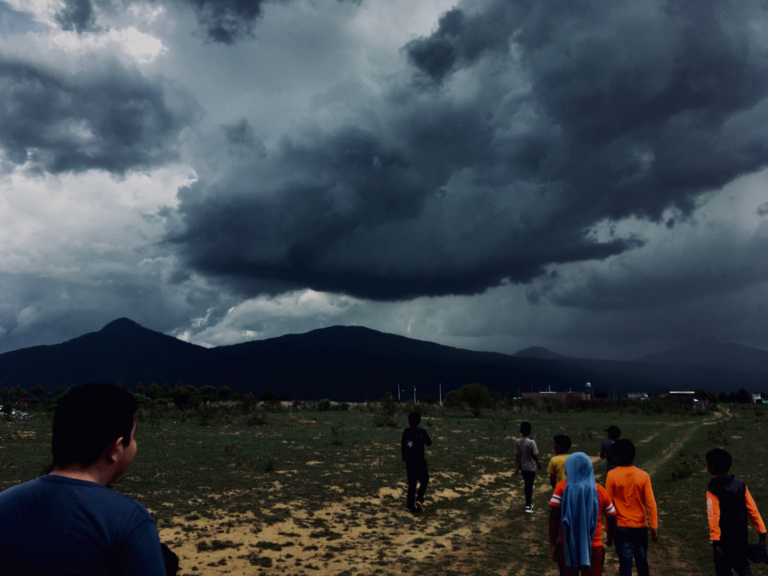
    Dawn opened behind the door, and I stepped through it, shivering a little, not quite awake yet. By five I was ready. Alex, Fede, and Pablo picked me up, and the four of us set out toward Nurio, wrapped in a cold that seemed determined to climb into the truck with us. The streets we passed let out only a thin thread of light; everything else was pure shadow. From the speakers came one pirecua after another—some we had recorded in recent sessions, others not, but familiar all the same.

    The world was still only a sketch when the community guard appeared at the entrance to Nurio, lighting us up with fluorescent lamps that sliced the night as if they meant to split it open. They asked where we were headed. Alex answered easily: to the lowering of the lantern pole. They let us through, perhaps because tradition has a way of opening paths that ordinary courtesy cannot.

    We waited for the rest of the group and then continued on toward a point on the hillside that, even now, I couldn’t locate again. The darkness made any attempt at orientation useless: everything was one long gray stroke. Only the silhouettes of a few trees stood out, silent witnesses to so many years of pilgrimage. But dawn began stitching light into the landscape, stitch by stitch, and the fog blended with the clouds as if they were the same thing.

    We found those who had arrived earlier: men of all ages, from seven- or eight-year-old boys to elders with experience written into their hands. They had already felled a tree and were organizing themselves to raise it, strip it of branches, transform it into the pole that would later become the village’s luminous sign. I was struck by how naturally each person knew what to do—how to tie the rope in the right place, how to balance the trunk, how to guide the younger ones with a word or the smallest gesture.

    Then the music arrived. They set up the instruments and microphones right there, in the middle of the hillside, as if electricity too had always been part of the rite. The pirecuas rose into the fog and mixed it with voices. Someone passed with a bottle of charanda in hand; someone else offered sandwiches still warm. It was a kind of togetherness that didn’t need announcing—it was already there, moving among everyone.

    Only men took part in the work of the tree, though all around there were presences and support of every kind. They told me that every December 8th, no matter the day of the week, the town gathers for this same labor. Many travel from far away, from wherever they now work or live, so as not to miss the date. One of them came over to talk with me. He said that although the celebration is for their people, they are always glad to welcome those from outside; that what’s beautiful is sharing, opening the space so others can understand—even a little—what this tradition means.

    And that’s how I lived it: as a warm invitation, an unexpected gesture of hospitality.

    Meanwhile, the tree kept changing. Some stripped it of branches, others lifted it, others dragged it. A few young men climbed the trunk with the ease of those who have grown up watching this happen every year. The music went on, shifting rhythm according to who asked for their favorite pirecua. Voices mixed with laughter, instructions, the faint crackle of fog.

    Someone explained to me the reason for the lantern: each year, a family safeguards the image of the Christ Child, and the pole—with a star or a lantern at its tip—marks that place so the village knows where the dances, the shepherds’ play, the prayers, and the gatherings that sustain the spirit of the community will be held. It is a simple but powerful way of orienting life toward a point: a light that shows where stories, memories, and prayers will come together.

    The day left me with the feeling of having witnessed a living weave: different hands interlacing to raise a symbol that belongs to everyone. The tradition did not explain itself with solemn words; it explained itself in the way those men worked together, sang together, laughed together. And one comes to understand that some customs don’t need to be fully deciphered: it is enough to see them breathing.

    What remains in me is the lit fog of that morning, the music that accompanied the cutting of the tree, and the unexpected certainty of having been welcomed by people who care for what is theirs without closing themselves to anyone. Traditions like this, when looked at closely, reveal something we don’t always know how to name: an ancient and luminous way of continuing to be a community.

  • Hunger to be loved

    I never knew what envy was.
    I watched it pass by every evening
    like people you cross on the road:
    nameless, faceless, soundless.

    I was whole.
    Or so I believed.
    The world owed me nothing.
    Not a house, not a body, not a laugh.
    And though I walked with empty hands,
    I had enough for everything.

    Until I saw.

    I saw people coming together like water gathers.
    I saw two shadows become one.
    I saw mouths seeking each other
    like animals that recognize each other in the night.
    I saw hands staying.
    Breasts learning each other.
    Names becoming home.

    Then something opened inside me
    like a crack opens in the earth.

    It wasn’t courage.
    It wasn’t hate.
    It was a hollow.
    An ache.
    Like hunger, but in the heart.

    And I knew
    that’s what I envied:
    not the bodies,
    not the laughter,
    not the happy photos pinned to walls,
    but that invisible thing that held them up.
    That which made them stay.

    I grew old without wrinkles.
    I grew old from wanting.

    From piled-up want.
    From want with no way out.
    From spoiled, wasted want.

    Everything stayed far from me.
    The songs.
    The outbursts of laughter.
    The intertwined hands.
    I stayed watching from the shore
    like someone watching a river flow by
    who doesn’t know how to swim.

    It hurts to see others embrace,
    as if it didn’t hurt.
    As if the world didn’t bite when it brings two souls together.
    It hurts because I too have arms,
    but I have no one to wrap them around.

    It’s envy, I say.
    But sometimes it feels like something else.
    It feels like hunger, and it feels like I’m dying from it.

    Hunger to love beautifully.
    Hunger to be a home.
    Hunger for someone to name me
    without my having to ask.

    I cry inside myself.
    My guts twist into knots.
    My mouth turns to desert.

    I wish I could say words
    that didn’t sound broken.
    Paint a portrait with the evening light.
    Give a flower that wouldn’t wilt upon touch.
    A song or
    a silence where two could fit.

    But here I am,
    alone,
    watching how affection leaves
    those who don’t care for it.
    And me,
    choking on this wanting.

    Wanting everything.
    Wanting nothing.
    Wanting her.

    I saw her.
    Not once.
    Many times.
    In many faces.
    As if the same fire
    were peeking through different windows.

    I learned she liked the earth.
    And I became hands.
    I became seed.
    I became furrow.

    I learned to plow.
    To sow.
    To tend.
    To wait.
    To harvest.

    My nails filled with dirt.
    My neck with sun.
    My days with long silences.

    But all that happened
    was she stepped on me.
    And she didn’t even know
    I was the dust rising onto her shoe.

    Later I learned she liked music.
    And I became an ear.
    And I became a throat.

    I listened to the birds
    split their chests open at dawn.
    To the rain dismantling rooftops.
    To the wind saying her name
    through the branches.

    I learned to sing.
    Not beautifully.
    Not loudly.
    But I sang.

    I made a music for her.
    A small music.
    A music that fit in the palm of a hand.

    She didn’t hear me.
    She covered her ears with her own noise.
    And left again.

    Later I learned she liked books.
    And I became a word.

    I laid them one after another,
    like petals forming a flower.
    I wrote a letter.
    Two.
    A notebook.
    A book.
    A whole lifetime in crooked lines.

    I wrote until I wore myself out.
    Until I was left with no ink and no voice.

    She never read me.
    Perhaps she didn’t understand
    the language in which I was breaking.

    So I sat down to think
    what else she might like.
    What else I could become.

    If she likes dusk,
    I’ll be the sun falling behind the hill,
    letting itself die slowly,
    bleeding gold and orange
    so someone might watch it.

    If she likes rain,
    I’ll be a dark cloud,
    a full belly,
    a drumbeat on the roof.

    If she likes the sea,
    I’ll be sand,
    so her fury might fade against me,
    even if she erases me.

    I want to guess her.
    I want to become a thing.
    I want to erase myself
    to fit inside her desire.

    But desire can’t be manufactured.
    And eyes cannot be forced.

    Today I understand
    that some distances aren’t measured in steps.
    That some names don’t belong to us.
    That some fires weren’t made
    to warm us.

    Perhaps I should surrender.
    Not like a coward surrenders,
    but like the evening surrenders:
    fully,
    soundlessly,
    letting the night do its work.

    No matter what I do.
    No matter what I become.
    There are gazes that don’t know how to pronounce our face.

    And here I remain,
    with my hunger sitting beside me,
    watching how the world loves itself
    without noticing
    those of us who learned too late
    that you can also live
    by watching the rain fall on foreign soil.

  • Cherán Atzicuirin: A León Native’s Perspective

    In 2023, the leaders of the musical groups SONAR Las Joyas from León, Guanajuato, and Tarhiata Jimpanhe from Cherán Atzicuirin—both ensembles made up of children and youth—organized a musical encounter in both cities. Cheranastico served as the first host of this event.

    León, Guanajuato, is a city defined by its industrial and economic orientation throughout its history. The expansion of urban sprawl has led to the destruction of flora and fauna, making encounters with nature an increasingly rare phenomenon for its inhabitants. For these reasons, my visit to Cherán Atzicuirin—a world completely different from what I had known—was a life-changing experience.

    Encounter

    Arriving in the community was like opening a window to an entirely new world: from the breathtaking views of mountains draped in morning mist, to the vast, eye-pleasing forests, to the clear, unpolluted nights free from smog and light pollution, and finally to its people, with whom I forged bonds that went far beyond mere words.

    The constant presence of nature in the daily life of the community is something utterly foreign to my hometown. Living in harmony with nature is an integral part of their lives and daily activities. Moreover, the pace of life I experienced and observed during my stay was much slower and more serene than the immediacy of urban life in León. This contrast led me to reflect on the differences in lifestyles between the two places.

    imagen_2025-02-13_104750326
    imagen_2025-02-13_104759115
    imagen_2025-02-13_104805515

    Although my time there was brief and did not allow me to delve deeply into the culture, lifestyle, and traditions of the place, I was nonetheless astonished and enchanted by the wealth of information shared by several community members. I was fascinated by the complexity of the Purépecha language and its regional variations. Their customs and traditions—evident in their community temple, which housed religious images adorned in ways unfamiliar to me as someone from León, and in the diverse resources within the church—clearly illustrate the differences and complexities between the religious practices of Cherán Atzicuirin and León. Their beautiful traditional garments (shawls, shirts, dresses), the intricate craftsmanship required to create each piece, and the deep social and cultural meanings they carry further underscore these differences.

    Their social organization, as a self-governing community, is entirely different from what I am accustomed to—not only in terms of social and political structures but also in the manner in which they elect their representatives. And their food? There is no better way to describe it briefly and succinctly than to say, “It is one of the best meals of my life.”

    All of these experiences were just a few of the many aspects I observed during my short stay. Although my understanding is limited compared to all that remains to be discovered, one thing is clear: daily life in Cherán Atzicuirin is deeply enriched by culture and community.

    The more I know

    Since returning to my hometown, my curiosity and desire to learn more about this community have only grown. In my opinion, it is impossible to know a place completely from every perspective, yet I hope for an opportunity to find answers to the questions I have now—and to those that may arise in the future.

    It is important to revisit the point mentioned at the beginning of this article: the musical encounter between these two groups sparked a series of events that demonstrated that, despite their many differences, nothing stood in the way of forming profound bonds through music and shared words. Studying and conveying the essence of this cultural encounter is no easy task, but the constant thread throughout all these experiences was music—the reason we gathered, the reason we learned about one another, and the reason that allowed me to see those mist-clad mountains, starry nights, hear traditional sones composed by community members, and share moments with the wonderful people of Cherán Atzicuirin.

    My visit to Cherán Atzicuirin marked a turning point in my perspective and raised many questions about the way I view León. One significant reflection was to question the exclusively industrial focus that León has maintained throughout its history—the daily challenges that come with it and the developmental path the city is now following.

  • The ones who stayed

    In this land of old stories and cherished customs, of the scent of burning wood, where time is measured in handfuls of earth and love is kneaded with patience before turning into a tortilla, my feet cling to this soil like roots to a clay pot.

    I did not cross the desert, nor the Río Bravo, nor did I venture into the uncertainty of a one-way journey. I remained tied to the invisible threads that bind me to this place, where my people are, where my dead rest—the only life I have ever known.

    My mother, with eyes full of fear and hands weathered by the work of the house, held us close to her bosom, recounting tales of perilous journeys and unyielding deserts: we were born as women.

    Her words, laden with wisdom, echoed deep within my soul. The fear of the unknown, of the hardships along the way, outweighed the promise of an uncertain future.

    Here, amidst the aromas of beans slowly simmered over a gentle fire and the sound of water boiling for coffee, I was taught to sew and embroider—and I continue to weave stories. Here, I found my place.

    In every stitch, in every kernel of ground corn, in every word shared, I build my own story, woven with threads of tradition and hope.

    The desert still beckons with its songs of freedom, but my roots have sunk too deeply into this fertile land. Here, among my own, I feel safe, shielded by the love of my family and the warmth of my home.

    And although I sometimes feel the pull of the unknown, I choose the certainty of what I have over the uncertainty of what might be.

    I am a daughter of migrants, like so many others.

    Those of us who remain proudly uphold the indomitable spirit of Mexico, so that, if one day those who ventured north return, they know that the stories of the men and women of clay have not vanished.

  • The Fire, Xakuarhu, and I

    Just over a year ago, my journey led me to Santa Clara for the very first time—a trip that left an indelible mark, a prelude to all that was yet to come. When word spread in Ocumicho that Santa Clara would host the event this year, my heart leapt with excitement. It wasn’t simply a visit; it was a summons to reconnect with deep roots, to rediscover the essence that binds our communities, and to feel the pulse of a past merging with the present.

    Step by step

    arrived in Santa Clara del Cobre at 4:30 in the morning. The night before had been a swirl of intense emotions, and a full day of restless anticipation had taken its toll—echoing the effort of a day when I had risen before dawn to set everything in order. In the quiet pre-dawn hours, the call of the Cupatitzio drifted into my ears—a chant that became my sole companion as I wavered between sleep and wakefulness. The unexpected chill struck hard, especially when I realized I had forgotten my heavy jacket at my grandmother’s. Yet, burdened with eight kilograms of camera equipment, my back found its own meager shield—a reminder with every step that my determination to continue was unwavering.

    I joined a slow procession toward the Dawn Ceremony, feeling as if the path itself whispered secrets. The normally bustling streets lay empty and hushed, cloaked in the quiet of night. The sound of footsteps on gravel, the sparse glow of a few streetlights, and distant murmurs merged into an almost mystical ambiance. Every sound—the crunch beneath our feet, the occasional clink, a soft burst of laughter—seemed to suspend time, transporting us far beyond everyday clamor.

    The Golden Anticipation

    As the darkness yielded to a timid gold along the horizon, a collective pause swept over us. We turned eastward, hearts brimming with expectancy as if standing on the threshold of a miracle. Though I caught only fragments of whispered words, the first cry of Juchari Uinapikua shattered the silence, the second sliced through the chill, and the third ignited an undeniable thrill. That raw sound seemed to awaken dormant souls, stirring the very spirit of the place. Even as joyful melodies and vibrant chants began to swell, earnest shushes restored a sacred quiet, halting time in a moment of pure communion.

    Soon, soft light bathed our faces, driving away the cold. Friends and familiar faces from Erongarícuaro, Uricho, Zacapu, Uruapan, and many other communities exchanged knowing smiles and brief, heartfelt embraces. After a cautious pause—waiting for permission to capture the moment—the band of participants burst into songs that beckoned us to dance. Traditions were passed along like torches as the day sprang to life.

    Xakuarhu

    In that moment, as we made our way back to Santa Clara—what I now fondly call Xakuarhu—each conversation and every encounter became a tribute to life itself. Neighbors stepped out to greet us with warm wishes, curious children peeked out from their doorways, and the sun, brilliant and unyielding, quickened the pace of our reunion.

    Reaching the plaza of Xakuarhu was like entering a microcosm of our shared world—a stage where culture and tradition revealed themselves in every corner. Artisans from diverse communities had gathered, offering their crafts for barter or sale. The air mingled with the aromas of sizzling carnitas, freshly prepared atoles, warm bread, and traditional tortas de tostada—each scent a promise of comfort and flavor. Everywhere, vibrant hues of green, yellow, blue, and purple celebrated the pride and identity of those who call these lands home. At the heart of it all, the yácata, vigilantly guarded by cargueros, waited patiently for nightfall like a sentinel of ancient mysteries.

    Before my eyes, the experiences of that day began to blur into something transcendent. The cold, the sleepless hours, the inner voice lamenting that “those shoes aren’t made for endless walking,” the hunger and thirst—all faded into the background. In their place emerged an extraordinary reality: the warmth of friends, acquaintances, and kindred spirits, each with their own story, their own struggle, and their own laughter. Every greeting hinted at a deep, possible connection, and my heart overflowed with gratitude and joy. I understood then why this reunion had grown to be so much more than a return to the past—it was a celebration of who we are today.

    Mojtakuni ka Uanopikua

    Every corner pulsed with exchanges—a vibrant festival of bartering, stories, and the shared aroma of home-cooked food. Anecdotes, dishes, and keepsakes flowed freely at every stall, each one a testament to a living culture in continuous dialogue with the present. The long, winding path became a bridge, uniting strangers and old friends alike, where the joy of meeting was as natural as the breath of life.

    When the Uanopikua began, it felt as if the universe had dressed for a celebration. Hundreds gathered in the main streets, eager to witness the brilliant display of colors and traditions heralding each community’s arrival. It was a reunion of souls—a heartfelt welcome to those who had once hosted these gatherings. Even as the absence of some familiar faces was felt, the presence of so many others filled the air with a bittersweet nostalgia and a renewed hope.

    For me, one of the most stirring moments was witnessing the active participation of the Indigenous Community of Paracho—a sight that awakened long-held dreams. I began to imagine a yácata rising in our own plaza, or perhaps within the old boarding school—a sanctuary where tradition might reconnect with the present. I allowed myself to dream of walking side by side with everyone to the “ánima sola” for the dawn ceremony, picturing the Uanopikua unfolding like a poem—from the deep resonance of a copper guitar to the imposing monument of the Purépecha mother, and back again, completing a circle that celebrated union and memory. That moment of dreaming felt as natural as breathing.

    We are Tinder and Flint

    The afternoon danced along with a playful urgency as the day filled with exchanges, laughter, and dances that echoed an inner fire. Music never ceased, and amid this joyful clamor, an almost tangible anticipation built for the moment the fire would finally be lit. Why this magnetic draw toward the unknown? Perhaps because within the flame lies the promise of rebirth—the power to overcome adversity—and a reminder that although we fear darkness, we are forever driven to light it up with our own flames.

    And then, at last, the moment arrived. With a gentle roar that soon became a shared murmur, the fire was ignited. The lively, unbound flames passed from hand to hand as the rhythmic hammering on copper announced the ritual’s climax. In that sacred instant, a chorus of voices rose in a hymn that transcended words and time—“Kanekua sesisti minkuarhentani p’urhepecheni”—and every trace of fatigue, cold, thirst, and hunger melted away. What remained was the profound harmony of a gathering that had reached a long-awaited peace and solace.

    Murmurs of a new host—Tinganio—drifted through the crowd like seeds of hope, promising fresh beginnings and new stories. It was then that I realized: burning does not mean being consumed by fire. To burn is to leave an indelible mark, to transform one’s surroundings, to consume the present and, in doing so, illuminate it with the intensity of our very being. It is to shine in every sense, knowing that even if the flame dies down, the spark to relight it endures.

    Today, as I recount these experiences, I understand that Xakuarhu, the fire, and I remain part of a vast narrative of reunions, challenges, and renewed hopes. May the fire never be extinguished in our hearts—and if it ever dims, may we always hold within us the seed to relight it.

    May the flame of life keep burning, reminding us that in every spark lies the strength of our roots and the promise of a tomorrow filled with new encounters and endless joy.