Categoría: Text

  • Beneath the Shadow of Kurhikuaeri Kuinchekua

    Not long ago, in Santa Clara del Cobre, the New Fire was kindled—a symbolic spark said to revive ancient rituals, rekindle collective memory, and forge an unbreakable bond with tradition. After the ceremony, the community of Tingambato was chosen as the host site. Yet what appeared to be a straightforward decision soon stirred up a storm of dissent. Critics argued that some communities “didn’t deserve” the honor, insisting instead that the celebration should have taken place elsewhere. In the midst of this age-old rite, a complex interplay of light and shadow unfolded: voices emerging from the depths of cultural identity, interwoven with traces of bitterness.

    Harsh sentiments were expressed by those who believed that only those who live and breathe the language truly grasp the essence of their heritage—that only fluent speakers can serve as the rightful custodians of tradition. Questions abounded: Must one speak Purépecha, have close kinship ties, chant ancient songs, or have endured discrimination in order to claim a stake in this living history? For many, these views only deepened the divide, marking those who fail to meet strict criteria as outsiders and reducing the ceremony to a mere spectacle.

    Amid the clamor, however, a thoughtful and calm voice emerged: Who truly holds the power to decide who is worthy of carrying forward this cultural mantle? Does excluding a community from hosting this sacred event somehow erase its existence? The reminder was clear—the honor lies not in claiming a superior version of cultural purity, but in embracing humility and embodying the spirit of kaxumbeti: serving one’s people with dignity and respect. History, scarred by migration and resistance, teaches us that true authenticity is measured not by the quantity of preserved customs but by the noble effort to protect what is sacred, free from the elitism that fractures communities.

    My own journey into the heart of the Kurhikuaeri Kuinchekua began with an insatiable curiosity to understand the ritual’s meaning and value. I ventured through pages of literature, engaged in heartfelt conversations, and sifted through memories in search of how a culture’s identity is truly forged—especially one that has long suffered from both external suppression and internal neglect. When the flame is ignited with the hope of reuniting communities with their roots, the pressing question becomes: Shouldn’t the chance to host come first to those who are drifting away, whose voices have been silenced over time?

    Sadly, the answer often becomes obscured by prejudices that are quick to divide what is inherently one. What purpose does it serve to belittle those who, for myriad reasons, have lost touch with parts of their heritage—just to elevate an unattainable ideal of cultural “purity”? Is authenticity really determined by birthplace, bloodline, or linguistic mastery? Or does the enduring spirit of our ancestors live on beyond every unspoken word? In many ways, this debate has taken on an ironic tone, echoing the unsettling reality that, in the name of cultural purity, some voices mirror oppressive ideologies more than genuine acts of resistance.

    The Kurhikuaeri Kuinchekua is not a medal to proclaim who is “more authentic,” nor a trophy that justifies looking down on others. It is a heartfelt call to awaken our collective memory, to recognize that culture is like a powerful river—flowing with countless stories and histories from every community, regardless of size, location, or language fluency. True tradition thrives in respect, in the humble act of sharing the fire without exclusion, and in rejecting narrow definitions that seek to confine our identities.

    Perhaps what is needed is a profound reexamination of how we define authenticity—a move away from rigid rules toward an appreciation of the complex legacy that each of us carries. This is a plea for reflection: to abandon divisive tendencies and acknowledge that, within the vast tapestry of Purépecha culture, every community survives because it endures, and within each of us burns an ancestral flame that remains vibrant against the forces of oblivion and discrimination.

    In the end, there are no winners or losers in this call for unity—only an urgent need for reconnection and reconciliation between who we once were and who we have yet to become. For in the whisper of the wind, the warmth of the fire, and the murmur of ancient voices, lies a simple truth: identity is a shared journey, with every step—no matter how modest—leaving an indelible mark on the history of a people who refuse to be divided.

    Perhaps the words of division come only from those who have never truly embraced this celebration; if they had, they would understand that when the fire burns, it offers warmth to all, and when it is shared, its light grows ever brighter.

  • Some Notes on Paracho I

    Some Notes on Paracho I

    Some time ago, I realized I know nothing about Paracho.

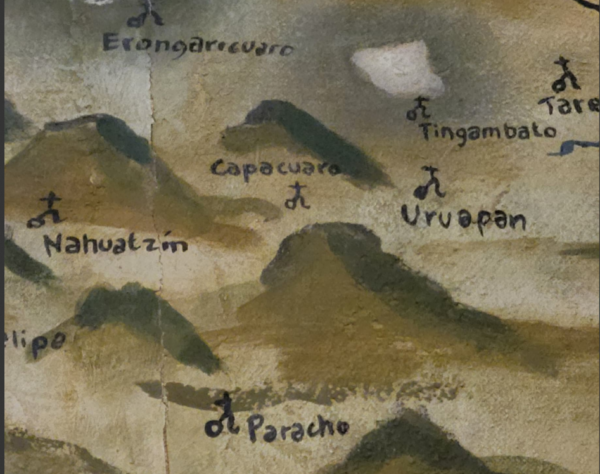
    We all know the myths about its origin, but none of those stories truly satisfy our curiosity. Some say we are Tecos who moved from El Paracho over by Lake Chapala, others that Friar Francisco de Castro secured these lands for us by requesting them from Aranza, Ahuiran, Quinceo, and Pomacuarán. Still others claim it was the Santo Entierro (Holy Burial) that decided we should stay here after the Old Paracho burned down…

    In short, we don’t know the truth. And I, not being an authority on history or a serious researcher, don’t presume to give you the definitive version. However, I’ll try to share what I’ve learned by questioning historians, musicians, researchers, and by reviewing various documents.

    It starts with a doubt


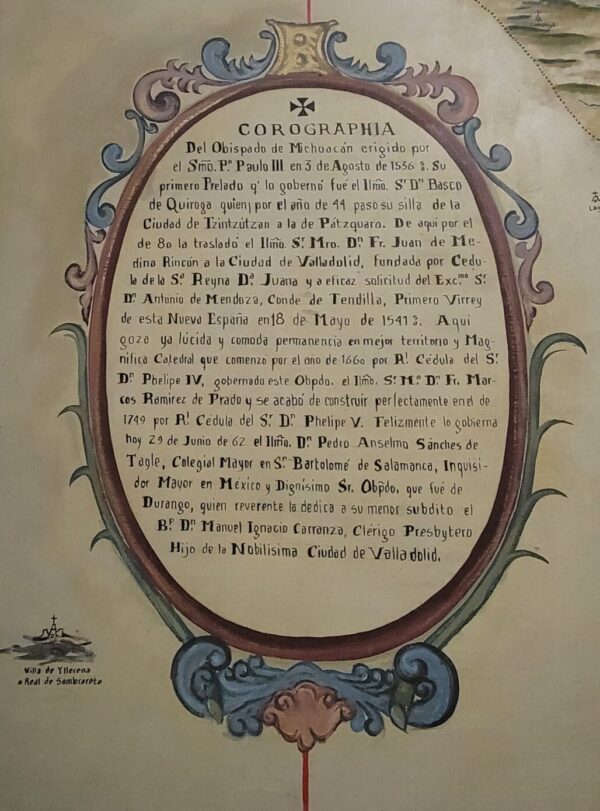
    In 1860, a document was presented to the Mexican Society of Geography and Statistics by Dr. José Guadalupe Romero. This document compiled various data about the towns of Michoacán. The book, titled Noticias para formar la historia y la estadística del obispado de Michoacán (News to Form the History and Statistics of the Diocese of Michoacán), provides us with the following information about Paracho:

    A town located in the Pátzcuaro highlands at 2° 45′ longitude and 19° 29′ 0” latitude from the Mexico meridian. It already existed at the time of the conquest; its name in the Tarascan language means Old Clothes, according to some, or Offering, according to others, depending on the word from which it is derived.
    In the year 1534, the indigenous people of this region were baptized by Franciscan friars Fr. Martín de la Coruña and Fr. Francisco de Lisboa.

    Sr. Dr. D. José Guadalupe Romero

    Paracho was already in its current location by the time the Spanish established the colony, which dismisses the idea that Paracho was formed due to Nuño de Guzmán driving the Tecos from their territory. Additionally, we can ascertain from some texts that the name “Paracho” appears to have a P’urhépecha/Tarascan origin.

    19. Parácho, San Pedro, (ó Paráche, ropa bieja; (*) El B. D. Manuel de la Torre Lloreda, honor de este partido. aunque créo viene de Parándi, ofrenda),

    Análisis Estadístico de la Provincia de Mechuacan 1822 Juan José de Lejarza

    Paracho. Paratsi-o, lugar de mantas hechas a
    mano, de lengua tarasca: la final de lugar o, y la radical
    parahtsi, manta o pieza de vestido.

    Nomenclatura Geográfica de México, 1897, Dr. Antonio Peñafiel

    As for the term “Chichimeca,” I find no further evidence beyond what is repeated over and over, from Wikipedia to the official website of the Paracho City Council, where, unsurprisingly, no sources are cited for this information.

    Walking backwards

    So, how do we uncover the P’urhépecha origin of our town if we have always believed a different version?

    In the Relación de Michoacán (1541), Chapter XXXI: How Hirípan, Tangánxoan, and Hiquíngare Conquered the Entire Province with the Islanders and How They Divided It Among Themselves and What They Ordered, it is mentioned:

    And Hirípan, Tangánxoan, and Hiquíngare entered their council and said:
    “Let us appoint lords and chiefs for the towns, as it will please the gods and bring peace to the people.”
    And they went through all the towns and appointed chiefs.
    The islanders took one part in the hot lands, and the Chichimecas another part on the right-hand side, in Xénguaro, Cherani, Cumachen; and thus, they pacified everyone. And a kingdom was formed. They also conquered Tacámbaro, Hurapan, Parochu, Charu, Hetóquaro, Curupu hucazio.

    This account further supports the idea that Paracho was already established by the time the Spanish arrived, having been conquered at some point by Tangánxoan and later becoming part of the Tarascan kingdom.

    Imagen de WhatsApp 2025-01-17 a las 20.58.32_dd891b8a
    imagen_2025-01-17_205403053


    As we move forward in the history of the town, we encounter blank periods, with little to no information for decades. So, let’s think: why do we still believe we don’t belong to this territory? Why do we still have that idea in our minds that we are not P’urhépecha?

    There are many factors that have contributed over the years to this way of thinking among the people of Paracho. The very loss of identity has led us to neglect our communal ties and focus solely on individual benefits. It has made us feel detached from our own surroundings and, even worse, we have excluded ourselves from our culture.

    A complicated path

    There is something that is often heard in Paracho: the phrase “No one is a prophet in their own land.” It seems that here they take it so seriously that they push you to fulfill it.

    There is a popular belief that foreign things are better. We see this in people who always seek American clothes, the luthiers who look for imported wood, those who prefer listening to Sinaloan music over Michoacan music, those who always seek English words instead of their regional equivalents. In short, the pop culture presented to us by cinema and television has swept away what once identified us as members of the P’urhépecha society. Women no longer wear naguas and rebozos as before, nor do men wear hats and sandals. In fact, it’s very likely that few people even know what the traditional attire in Paracho was, let alone ask for it to be used again. Our native language is no longer spoken, and even worse, there are many who deny their origins—those who proclaim that their birth certificate says they were born in Uruapan, Morelia, or Zamora, and despise their homeland.

    So, it’s not surprising that we don’t know where we come from, and because of that, we can’t complain about not knowing where we are going.

  • The Guitar Sings in Soledad

    The Weight of a Name

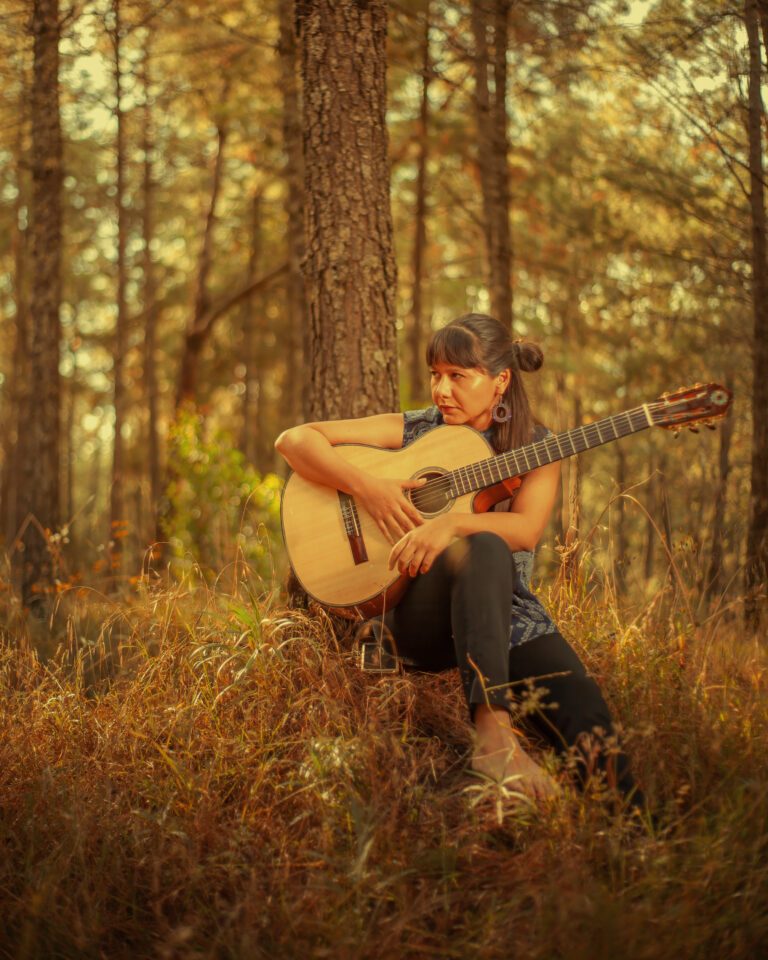
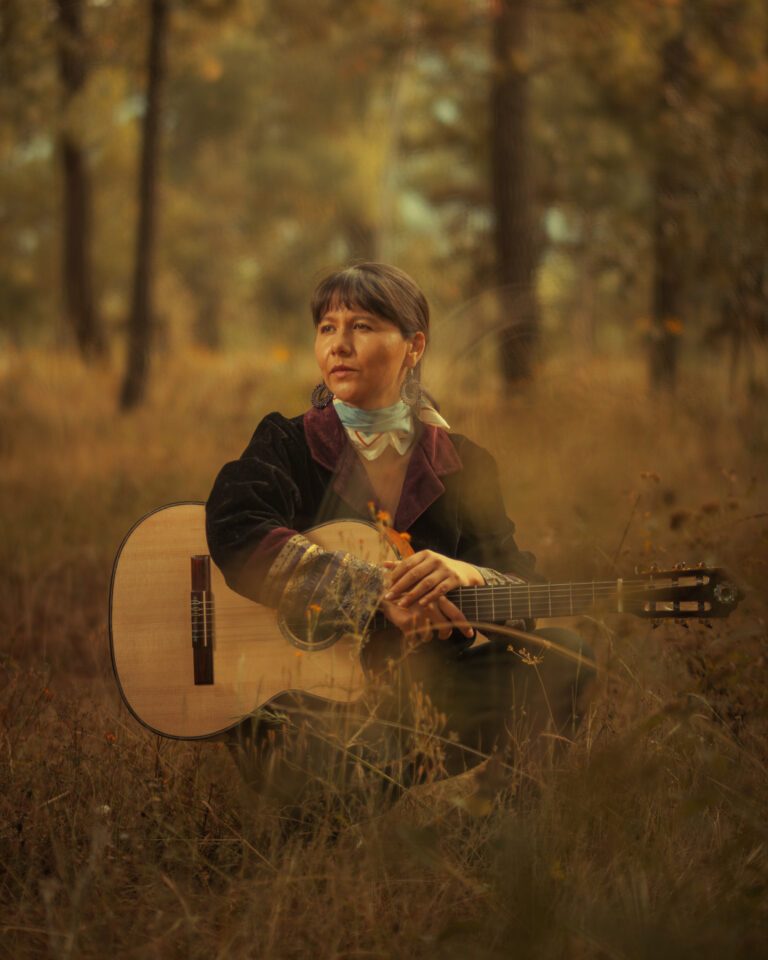
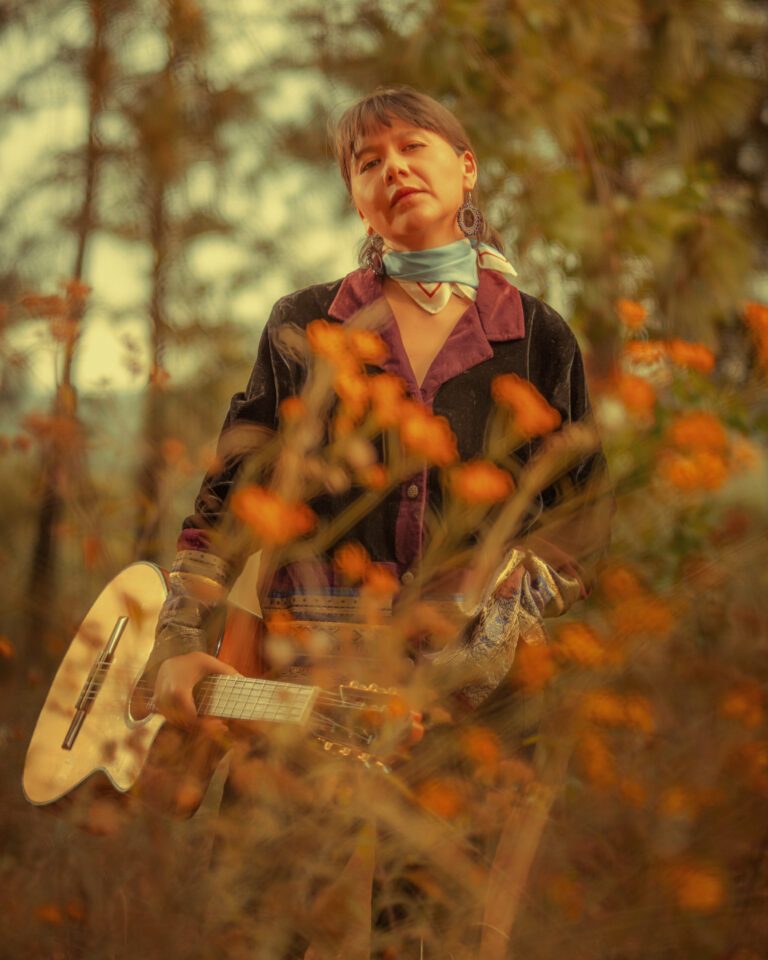
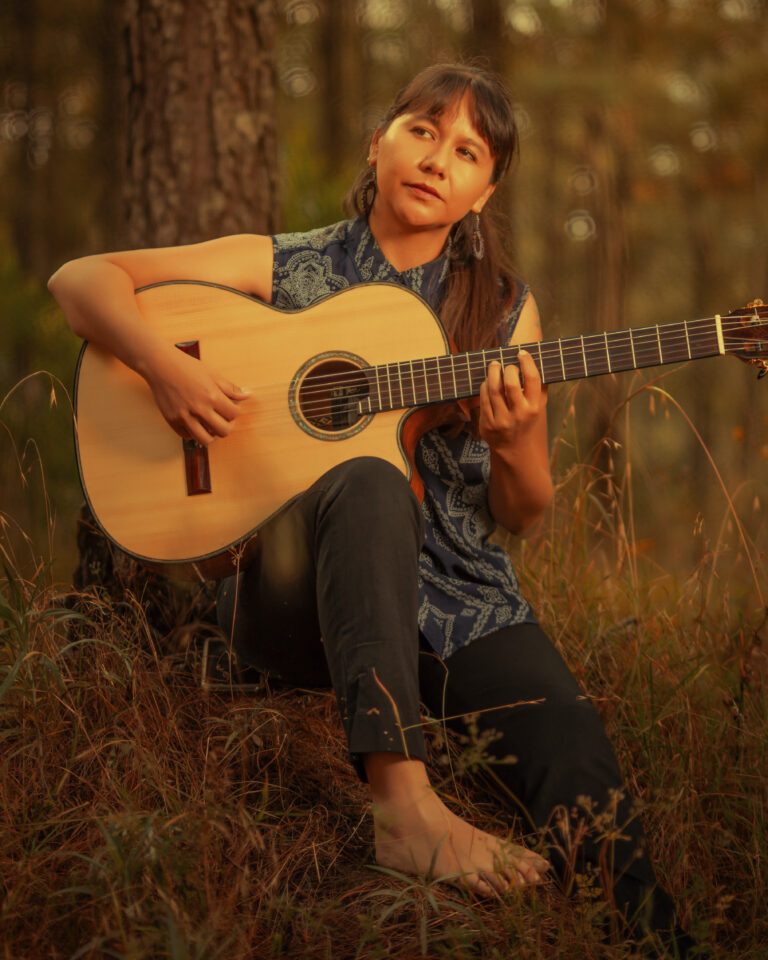
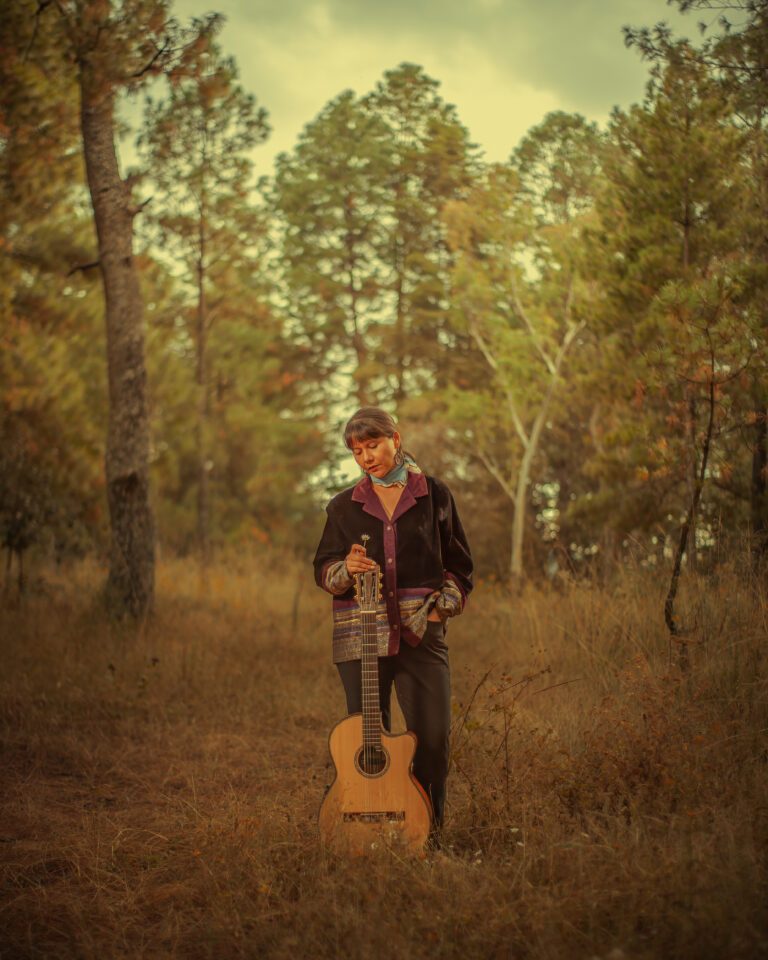
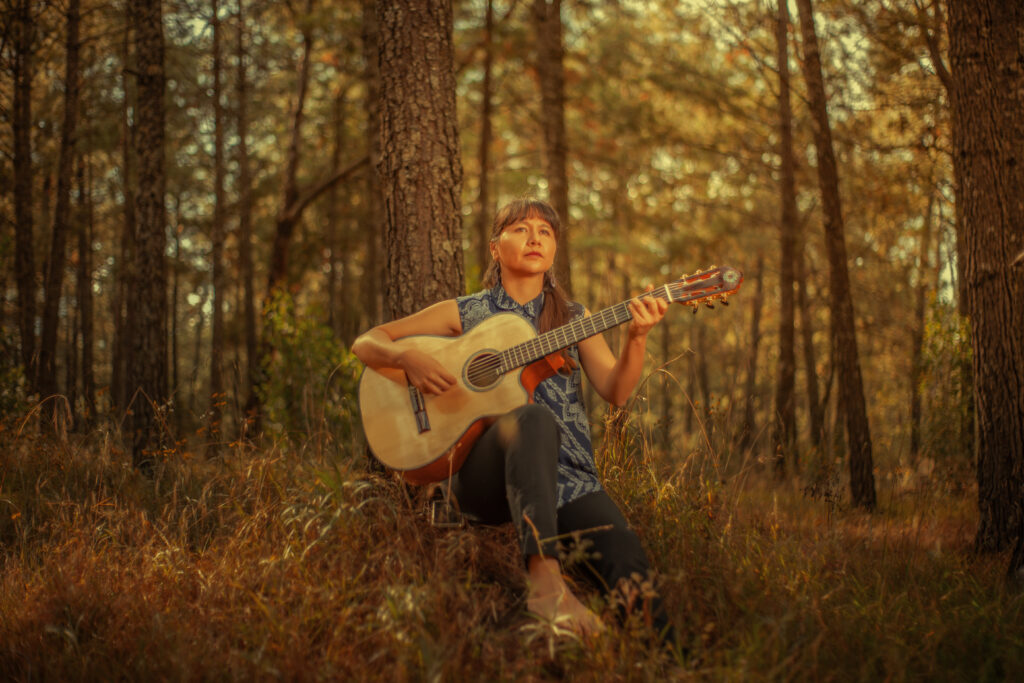
    Soledad Ulloa arrived in Morelia five years ago, bringing with her a guitar and a wealth of stories. When asked why she chose to call herself Soledad, she explains that it is her middle name, but she has adopted it as an act of introspection. “Soledad (Solitude) is not bad; it helps us distinguish and see the bigger picture.” Her name, like her music, is a way of inhabiting oneself, reconciling with loss, and finding strength in fragility.

    Soledad Ulloa
    La Guitarra canta en Soledad
    La Guitarra canta en Soledad
    La Guitarra canta en Soledad
    La Guitarra canta en Soledad


    The Voice of Nostalgia

    Soledad’s music is imbued with emotions that feel timeless. Influenced by Chilean cueca and Mexican ranchera music, her songs range from romantic to combative. In her melodies, nostalgia is not only a feeling but a starting point to tell the stories of what has been lived. I met her this year and later worked on the recording of Astro Brillante, a music video full of symbolism, dedicated to her sister Elizabeth and to those who have suffered losses.

    “Astro Brillante” is more than a song: it is an offering. Its release coincided with the anniversary of her sister’s passing, a September 11th that resonates not only in her life but also in the collective memory of her hometown.

    A session in Paracho

    For this edition of Kústakuni, we decided to work with Soledad again, recording a special session in Paracho, the heart of Michoacán’s guitars. The choice of location was not accidental. In the cold mountain air, her voice resonated with an authenticity that seemed to blend with the strings of her guitar.

    Her lyrics, full of protest and hope, found a perfect echo in the wood and mountains. In each chord, her Chilean roots intertwined with the strength of her present in Mexico.

    Singing to heal

    Soledad does not only sing; she creates to heal. Her upcoming album, Canto para Sanar, promises to be an intimate journey filled with symbols. On its cover, designed by @setornasol, the Copihue, Chile’s national flower, and Mexican votive candles coexist, symbols of rebirth, protection, and the connection between worlds.

    “We create to heal; there is no other reason,” says Soledad, and it is precisely this spirit that permeates her music. Through it, she invites introspection, inhabiting the losses, and finding strength in what was thought to be broken. It is clear: the guitar sings in Solitude.

    Sus letras, cargadas de protesta y esperanza, encontraron en la madera y las montañas un eco perfecto. En cada acorde, se entrelazaban sus raíces chilenas y la fuerza de su presente mexicano.

    Download audio files
    Soledad Ulloa

  • Petrichor

    This year has been a strange year, profoundly strange, one of those that seem heavier than all the others combined.
    For weeks we lived under a still sky, as if the sun, cruel and watchful, had decided to fix its gaze upon us to observe our despair. An infernal heat took hold of the days, suffocating, relentless. It tore away our spirits and revealed the worst in us, as if exhaling our frustration and cursing the thick air could offer us some relief, even if only illusory.

    For the first time in a long while, I was afraid. It was not a common fear, but an ancestral one—the fear of emptiness, of absence, of the possibility that the rains might never return. I imagined already living in a dry and barren world, a wasteland of dust where all that was green had turned to memory. I believed there would be no redemption, neither for me nor for any of us, but I also thought—selfishly, after all—that my suffering was unique, that I carried a weight on my shoulders that no one else could understand.

    Then, I prayed. Can you believe it? I, who have always mocked superstition, creeds, and prayers. There I was, on my knees, silently begging the mute sky, as if the voice of a broken man, a heretic like me, could pierce the heavens and summon the mercy of a storm. But the sun did not listen. Each day was a replica of the last: the dry and searing air, the dull gazes of those around me, the endless nights where sleep was a fleeting luxury, like a breeze that never arrives.

    And just when I thought hope had run out and that cruel fate would be our only companion, it happened. At first, it was but a few timid drops, as if they hesitated to touch the earth. Then, a roar from the horizon, a gust of wind filled with promises, and finally, the storm.

    What fury! It was as if the sky itself had decided to take revenge for our despair, to return to us all the weight of our prayers. The rains fell with such force that I thought the earth would crack in two. But in that violence, there was life. The dust faded away, the earth exhaled in relief, and within days, the paths were green once more. The air, now fresh and laden with moisture, was a balm for the senses. The birds returned with their songs, the crickets rose in a nocturnal symphony, and the trees… the trees seemed to raise their branches to the sky in a gesture of gratitude.

    And then you came, like a storm in the midst of my drought.

    I too, began to bloom.

    Violent, unexpected, overwhelming.
    I did not know what to do with the intensity of your presence, with the chaos you brought into my life. But with you, came the freshness, the life, the renewal. Your laughter was the rain soaking my dry skin; your voice, the river that quenched my thirst. I felt something within me overflow, how the sorrow, accumulated over the years, slipped through my cracks, leaving me light, renewed.

    Have you ever smelled the fragrance that rises when the earth is moistened after a long drought? They call it petrichor, and they say its essence comes from the blood of the gods spilled upon the stones. How poetic, right? But I wonder: what fragrance do the gods leave when they walk among mortals? Because what you leave in the air can be nothing other than divine. What is this essence of yours that has spilled over me? It is something deeper, something inexplicable, something that resists me yet invades me at the same time, something I cannot name, but long to explore.

    Since you arrived, I have begun to see the world with new eyes. The days are no longer a punishment; even the nights have a new light, as if the moon itself knows I am with you. And yet, I wonder: how is it possible that a storm can bring so much peace? How can someone, with all their force and fury, become a refuge?

    Perhaps I will never find the words to describe what you mean to me, but there is one thing I do know: you are my rain, my storm, my salvation. And I, like the earth after the drought, can do nothing but bloom.

    I hope that together, we will discover what we are. What new paths this water, now flowing through us, will carve. I hope, with all the humility of one who has known drought and the gratitude of one who has been saved by the rain, that this storm of ours never ceases.

    With all the emotion of one who has returned to life,
    Always yours.

  • I don’t know, I love you

    I love that which I cannot comprehend,
    and thou art, to me, a divine enigma.
    Do not fear to ask how much,
    for the “how much” is but a cage without keys,
    a bottomless abyss, endless in its call.
    Love hath no weight, no form,
    it is like the horizon:
    always present, yet always beyond.

    If only I could tell thee how I love thee,
    the words would fall like withered leaves.
    Numbers, those frail creatures of the mind,
    would lie spent upon the earth,
    unable to measure what is infinite.
    Not the grains of sand,
    nor the stars that flicker,
    nor the drops of the sea,
    could contain the vastness
    of what I feel.

    To what length might this love guide me?
    Perhaps to the edge of the roads,
    where the wind returns unto itself,
    where the sun rises for the first time,
    where the night surrenders its last shadow to dawn.
    And even there, at the world’s edge,
    thou wouldst find me with a simple word,
    so common that it seems unworthy of thee:
    I love thee.

    This clumsy tongue, so bound to the mundane,
    refuses to give me the perfect verb.
    Perhaps in some faraway tongue,
    there exists a sound that speaks of the very soul,
    something that embraces the ungraspable.

    But until that day,
    I cling to the hollow that we are,
    to this echo that cannot be filled,
    to the hope of finding that word tomorrow.
    And until then, keep asking how much,
    for with each question,
    I love thee more,
    and with each attempt at answer,
    the infinite draws closer.

  • In her eyes

    One must invent a word, true and grand,
    that captures what the eyes contain within,
    for though the gaze may seem to merely stand,
    it does much more: it wakes the soul from sin.

    In them, the world itself does pour and spill,
    love and hate, loneliness and fire’s flame,
    a mirror true of all humanity,
    a beacon in the fog, or fire that calls our name.

    What then do eyes do, if not to behold?
    They are the port where the soul finds its guide,
    and a book where the day’s journey is told.

    They are the key to life, to all its meaning,
    a deep sea, calm or filled with death’s wailing,
    that reveals the soul, and its quiet beating.

  • It’s not absence

    I don’t know if I should call it absence,
    when in every corner of this house
    you leave your shadow hanging.
    The air fills with your steps,
    even though I don’t hear them;
    and the walls whisper your name,
    without me asking them to.

    You’re not far.
    There’s no distance between the memory
    and the weight of your laugh,
    which stays here,
    as if it had made a nest.

    Your voice doesn’t fade,
    still wandering between the days,
    blending with my own thoughts,
    as if you were the thread that holds my silence.

    I don’t know if this is absence.
    How can I call it lack
    when you never fully leave?
    How can I feel emptiness
    when your presence settles
    like a dim light,
    that doesn’t seek to shine,
    but never ceases to be?

    You, who are not here,
    but always are.
    Every day you leave
    and at the same time you stay.
    No, this isn’t absence.
    It’s another way of being,
    one that knows no borders
    or bodies, or time,
    we are, because we have each other.


  • Do you think of me?

    Do you think of me
                 the way I think of you?
                             No, of course not.
    I’m certain you don’t.

    Your mind roams paths I’ll never know,
    wandering through the hills,
    chasing the shimmer of the horizon,
    where my eyes can’t even dream to reach.
    Your thoughts are vast,
                 like endless lands,
    while mine, instead,
                 have no destination but you.

    I don’t blame you.
                 This isn’t a reproach—it could never be.
                             I understand.
    Time slips through your hands,
    fleeting with the weighty things,
    those that truly matter in life.
    And I, I have so much time,
    so much, so empty,
    that I can fill it entirely with you.

    So here I am,
    searching for you in the words you left behind,
    turning them over like stones in a river.
    I take them,
                 I turn them,
                             I caress them.
                 I try to learn them,
    to chew them,
    to understand what you meant,
    if you meant anything at all.
    And all the while,
    you remain out there,
    somewhere I can’t reach,
    with no time to stop for me.

    But still, this isn’t a complaint—
    how could it be?
    I understand, lives aren’t lived the same for everyone.
    You have hands for the tangible,
    for what’s built and remains.
    And I, I have only dreams.
    Dreams and this yearning to
    drown you in words
    I don’t know if you’ll ever hear,
    to write you on paper
    you’ll never read.

    I know there are things inside you
    I can’t begin to grasp,
    things that slip away
    like water through fingers.
    But that doesn’t matter, either.
    I have time to spare.
    So much time that
    even the silences you leave behind,
    I’ve learned to fill with your absence.

    Sometimes I think
    you’re like the wind that blows
    but can’t be caught.
    You brush past me,
    leaving my hands cold,
    but you never stay.
    And I, like a fool,
                 stand still,
                             waiting,
    hoping that someday you’ll change course,
    that you’ll stop, if only for a moment.

    I wonder if you’ll ever stop.
    If one day, you’ll look back and see me there,
    waiting in the shadows.
    But maybe not even that.
    Perhaps my fate is to bear this waiting,
    this certainty that your steps won’t return,
    that your eyes are always set forward.

    And yet,
    I can’t let go of hope,
    foolish as it is.
    Because, even if you don’t want to,
    even if you never come back,
    I’ve planted you inside me
    like a tree.
    And no matter how tall you grow
    or how far your branches spread,
    I’ll stay here, tending to you
    from this distance you don’t even notice.

    There are days when I wonder if I made you up.
    If what I think you are
    is just my dream,
    a reflection I conjured to feel less alone.
    But then you reappear,
    like a ray of light
    breaking through the clouds,
    and everything hurts again,
    just as it always does.

    And even so,
    I have no regrets.
    Because even this pain you leave me
    keeps me alive,
    reminds me I’m here,
    waiting.
    So I ask myself:
    Do you think of me?


  • Wave

    I saw the ocean, deep blue and weightless,
                                      rising toward the shore.
    I watched that immense wave break upon the rocks,
                                      its fury spilling out,
    shattered into a billion fragments of defiance.
    In that moment,
    I felt small,
             minimal,
                   fragile,
                        wordless,
    my breath frozen in awe.
    A shiver,
              an omen,
    coursed through me.
    I thought of the power, so immense,
    required to move even a fraction of that force.
    I thought of the cold,
                                 the wind,
    the overwhelming weight of it all.
    I saw the flash
                  but had not yet heard the thunder.

    And all I could think of was you.
    I had seen this same force in your gaze,
    and though it was beautiful and terrifying,
    it was nothing compared to you.
    And no,
                   I do not fear you,
                             though surely I tremble.
    Because you are the sea,
                    the storm,
                                  the fire.
    You are magic,
           superstition,
                 the creed,
                       the miracle.
    You are cloud,
           lightning,
                 wind,
                       mist,
                             and ice.

    You are the moment that turns into tempest,
                       stopping everything,
                 staining everything.
    You are the roar that brings it all crashing down
    and the silence that follows the void.
    You are the mystery
    of what horizon?
    an abyss of light
           and shadow
                 that calls to me
                       and drowns me.

    There is no truce with you,
    nor do I want one.
    Because in your chaos
           I find order,
    in your fury,
                 the calm I do not seek
    but that finds me.
    You are the fire
           that consumes me
                 and shapes me,
                       the wave that crashes
           and rebuilds my borders.

    And even so,
    I cannot encompass you.
    You are everything and more.
    You are the earth’s cry,
    the sea’s whisper.
    And I, a mere witness,
    am lost in the vastness
                 of feeling small before you.

  • Rebozo II

    From the navel, sacred knot of life,
    a thread ascends to dance with the sun,
    woven in gold, in shadow, free of strife,
    a mantle embracing the heart as one.

    A subtle feather, spreading in its flight,
    like a flower spilling colors on the field,
    so too the rebozo, in its woven might,
    holds love in every thread it dares to yield.

    Oh, divine light, caressing as it glides,
    revealing skin, yet guarding it with care,
    a veil of joy where the soul resides,
    a warm embrace, Eden’s breath in the air.

    And in each strand the loom entwines with grace,
    dwells whispers of an ancient, timeless song,
    the hands’ soft hymn, which never leaves its place,
    weaving the rebozo, where art belongs.

    You who carry its weight, its tender plea,
    can you not hear the voices of the past?
    It’s feather, flower, light, and purity—
    the rebozo, eternal, in your soul held fast.